Birth, facts and some pieces of the puzzle of an unusual life, year by year to the present.
1966
The 18th of August is commemorated the death of, at least, four popes: Sixto III (dead in 440), Adrian V (in 1276), Alexander VI (in 1503), Paul IV (in 1559).
On the 18th August 1966, the first ship-to-shore satellite radio message was sent, and in San Miguel (Buenos Aires) appeared for the first time a creature who was named Gustavo Eduardo Charif al-Hāshim. That day, more than a million of Red Guards make their first public manifestation at the Tiananmen Square of Peking. The youth battalion march for the Cultural Revolution singing 《大海航行靠舵手》 (“Sailing the Seas Depends on the Helmsman”).
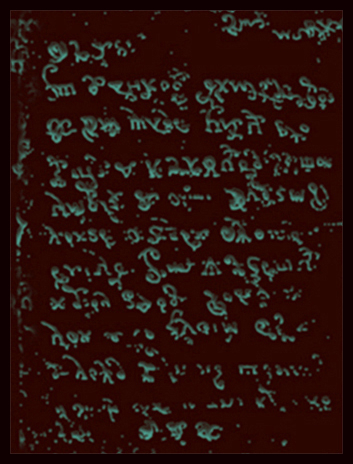
Extraordinary photography showing marks made by the foetus Charif in the maternal womb. Irrefutable proof.
(© Charif Org 2005)
That same day, Roman Polanski turns 33 years old not knowing yet that Ira Levin was finishing writing the novel Rosemary’s Baby, and Vincent Bugliosi, the district attorney who successfully prosecuted Charles Manson and part of his “family”, turns 32 years old. And that same day, The Beatles reached number one in UK music charts with Yellow Submarine.
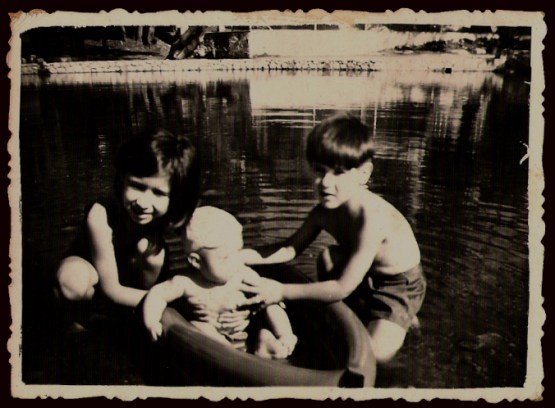
Sister and brother trying to get rid of the little monster, sending him through the river
None of these history facts is directly related to Gustavo Charif, but they place us in time.
1967-1972
Charif imagines his first short stories and made his first paintings. Soon he learns to write backwards, and has nightmares that continue in his wakefulness as hallucinations.
At the age of five, his parents present him with a toy projector Cine Graf. He paints an extensive parchment paper using it as a filmstrip to adapt a book called Cabeza de fierro (in English: “Iron Head”). As his sister and brother read the text while he projected the handmade film.
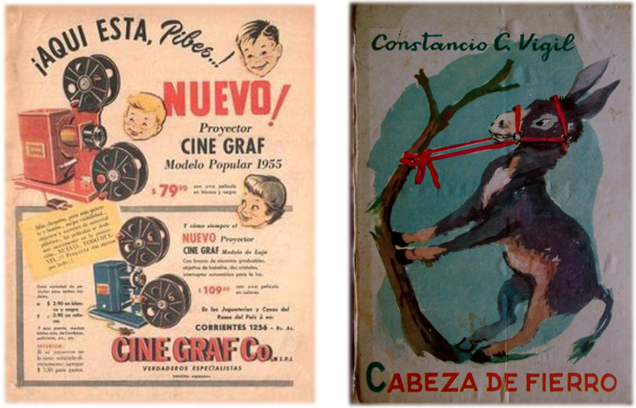
Advert of the projector-toy in old Argentine magazine, and cover of Cabeza de fierro book
Together with his cousin Marcelo Uriona (1965-1993, who would later be a remembered actor of German plays and films under the direction of Peter Kern, Werner Schroeter or Monika Treut), they stage his first theatre plays, at his godmother’s cabaret In Pergamino (in afternoons, before adult shows).
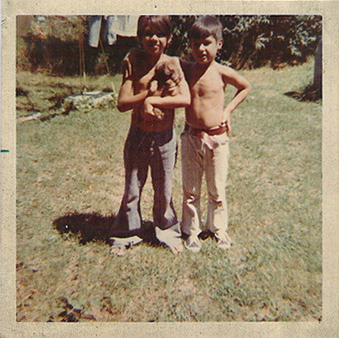
Marcelo Uriona (with defunct creature) and Charif
1973
Impressed by some old films like Le joueur d’échecs (Jean Dréville, 1938) and Return from the Ashes (J. Lee Thompson, 1965), Charif begins to take interest in the “elegance of the logic” and in chess, a game that would become cardinal in his life.
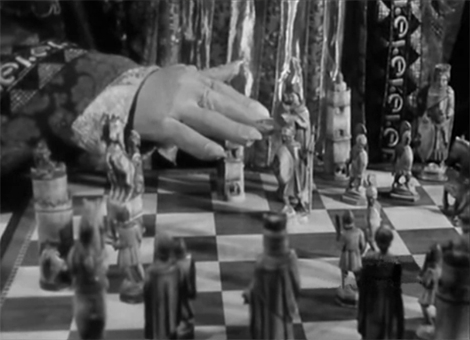
Film still from Le joueur d’échecs (Jean Dréville, 1938)
His parents send him to study folkloric dances and, one month later, he is selected to make his debut in a play about the Argentinian Conquest of the Desert. After the premiere he renounces for ever to folklore, due the music results him terrible boring, and becomes interested in Stanley Donen and Vincente Minelli’s musicals.
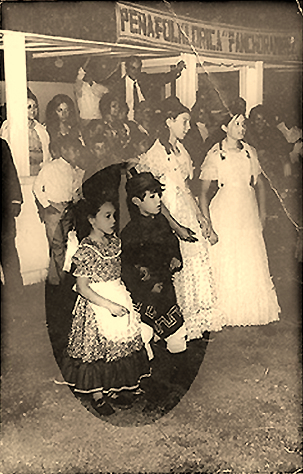
Charif in the Conquest of the Desert
1974
Becomes in a big fan of Leonardo da Vinci, and at same time rejects the aesthetic from Michelangelo Buonarroti, especially by the masculinized female bodies of Michelangelo.
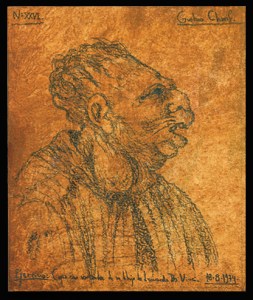
Copy of a Leonardo da Vinci drawing made by Charif at eight years old (1974)
1975
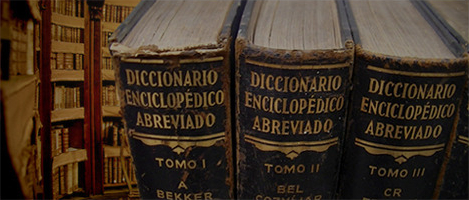
Spends long time reading and glancing the nine volumes of the Diccionario Enciclopédico Abreviado (a large Spanish Dictionary published by Espasa-Calpe), which would become major literary influence of his life, or maybe the only big literary influence.
1976
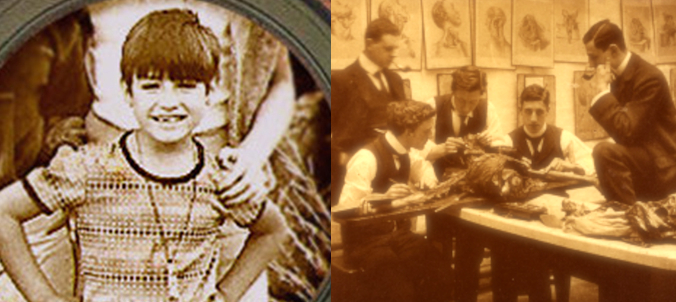
Charif around the time of the surgical intervention
With regard to this year, in which he had to have surgery in a risky operation, Charif would say: “The high levels of corruption in the government Peronist party had their peak in the last official speech from President Isabel Perón. See her on TV, boasting and laughing at the face of people, was absolutely fantastic. Frightfully fantastic. I was nine years old but that single image confirmed to me the rotten nature of this neo-fascist “movement” called Peronism… but also the weakness of most Argentinian people who accept this kind of political situation over and over again…”
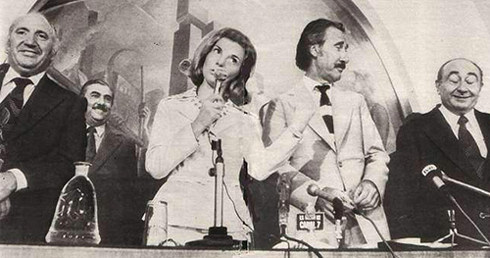
Lorenzo Miguel (labor leader of the Union of Metallurgy Workers, UOM), President Isabel Perón, Casildo Herrera (labor leader of the General Confederation of Labour, CGT), and Emilio Mondelli (Minister of Economy) laughing at the people
“…but soon this government would fall, and something incredible worse would come: the almost eight years of the bloody military dictatorship”.
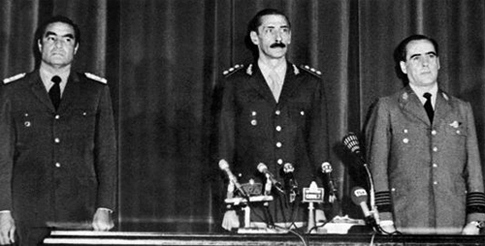
The “military junta”: Admiral Emilio Massera, Lieutenant General Jorge Videla and Brigadier General Orlando Agosti (from left to right)
1977
Starts to experiment with different techniques and all kind of materials on canvas, paper and stone: gouache, shoe polish, dyes, enamel, tea, coffee, inks, stones, objects, fire, glues… His first collages are from this time.
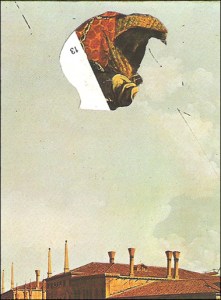
“13” (circa 1977). Collage and ink.
1978
The FIFA World Cup, the international football world championship tournament, was held in Argentina between 1 and 25 June.
“When most people was celebrating triumph of national football team, within walking distance, other people were being tortured. Let’s imagine, for example, a victim of the Military government, when in a clandestine prison hears, at distance, a multitude screaming goal!!! minutes after or before the picana (one of favourites torture method in those years) restart its work.” -Gustavo Charif.-
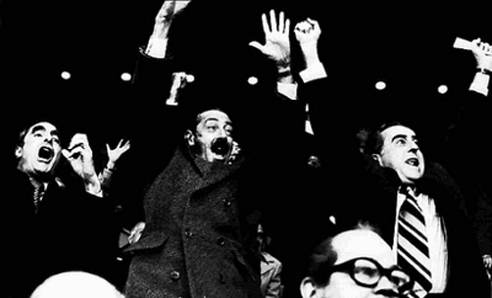
Admiral Emilio Massera, President and Lieutenant General Jorge Videla and Brigadier General Orlando Agosti celebrating the last goal in 1978 FIFA
1979-1981
Charif attends secondary education at an institution run by Franciscans nuns in José C. Paz (Buenos Aires). There he meets Daniel Capanna (son of the essayist specialized in science-fiction Pablo Capanna), and together founds an alternative magazine specialized in literature that Charif runs. This magazine organizes at the same time rock festivals in the parish church of the town.
At the same time Charif attends at literary workshop in the Casa de la Cultura (cultural municipal institution) of San Miguel. Three years later he gets the diploma of Technician in Literature, at the age of fourteen.
A wide variety of interests characterize this period, including connections between the physics and paranormal, history of religions, history of Satanism, logic, chess, and even football (he play in different teams), but always keeping a skeptical spirit.
However, about those years, Charif will recalled that “increasingly, I got lost on the streets, when I should go on the way to the school”.
In an agnostic period, but inspired by the reading of the great Spanish mystics, he pilgrims to Basilica of Our Lady of Luján with numerous believers. In that trip he has sexual relations for the first time, thanks to the services of a two years older Christian girl. After this peregrination he recovers the absence of faith, the atheism that marked him from birth.
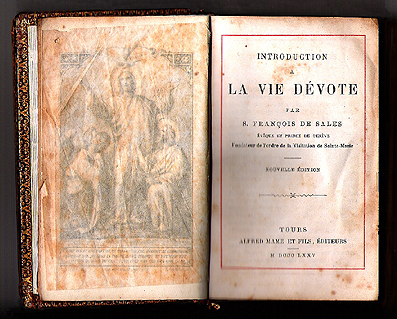
A 1875 edition of Introduction à la vie dévote (Introduction to the Devout Life) by François de Sales, from the Charif’s adolescent library
From 1979 to 1981, Charif composes about 400 songs, plays bass in a jazz trio, sings and plays guitar for different rock bands and writes about thirty books (that will destroy at the age of 20). Finally, at the age of fourteen, he meets a talented guitarist called Juan, with whom creates his own band. Although, soon later, this musician die in a gunfire trying to rob a shop.
After the economic collapse of his parents, his family opens a bread trade in the municipal fair. This will be the first of numerous employments in Charif’s life (book merchant, waiter, cook, home delivery book seller, house painter, translator, teacher of the most diverse disciplines).
At this time, he make a series of variations and art interventions on Old Masters (Poussin, Rembrandt and Zurbarán among others).
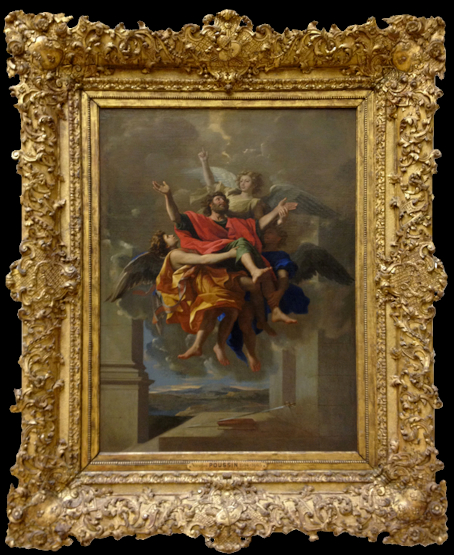
Le Ravissement de saint Paul (1649-1650) by Nicolas Poussin
oil on canvas · 148 x 120 cm · Louvre Museum
Please, click on thumbnails to enlarge


In 1980, made a series of oil pastels on paper (combined them with different techniques and materials): Duelo a muerte entre visitantes de distintos planetas (Duel to the Death Between Two Visitors From Different Planets), Llanto de un indeciso (Crying of an Undecided), Minotauro blanco (White Minotaur) and Núcleo (Nucleus), among other works.
Please, click on thumbnails to enlarge


In 1981 Charif becomes interested in alchemy, sexual life of insects, automatons and marionettes, and tries to develop, based on his own childhood’s memories and nightmares, a voluntarily hyperesthesia.
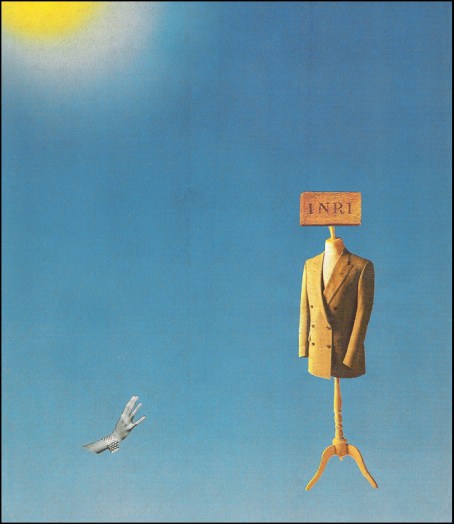
La religión, la moda (Religion, Fashion) · collage · circa 1981
In this year Charif read for the first time to Marquis de Sade and starts an investigation about his life and the extensive collection of documents and different editions of works from and about him. First books by Sade that he read are Les Cent Vingt Journées de Sodome (1785) and Dialogue entre un prêtre et un moribond (1782).
“I never was a fan or an admirer of Sade, but I studied him as a three branches tree: a natural phenomenon, a symptom of his times, and a thinker who had the ambition to explore the human nature beyond the surface thoughts of Voltaire and Rousseau about the same topic. But furthermore, Sade represents to me an enigma and a key to understand how intelligence should not be confused with wisdom, how a man extraordinary intelligent can be at the same time extraordinary stupid and lacking in wisdom when more he need it.” -Gustavo Charif.-
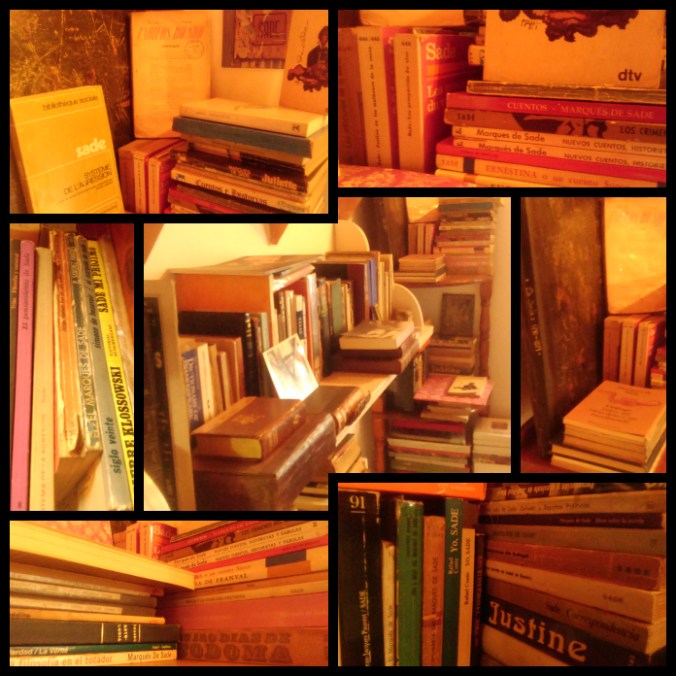
Sade collection corner in Charif’s private library
 Charif · 沙里夫 ·