Birth, facts and some pieces of the puzzle of an unusual life, year by year to the present.
1997
On January 1, in response to the fax sent a month before, with a short letter and a scene from his play Misa Negra, Gustavo Charif receives a postal message from Fernando Arrabal. That was the formal start of a correspondance and friendship that lasts today.
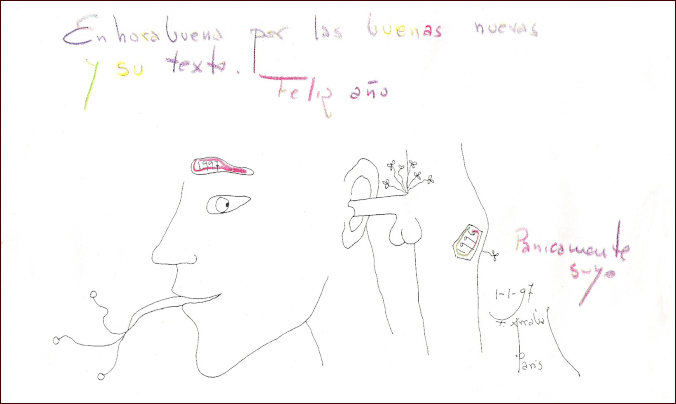
First postal message send from Fernando Arrabal to Gustavo Charif (1996/1997)
In the following months, re-edites some of his first experimental films, and creates stages for a Jorge Polaco‘s film about Albrecht Dürer.
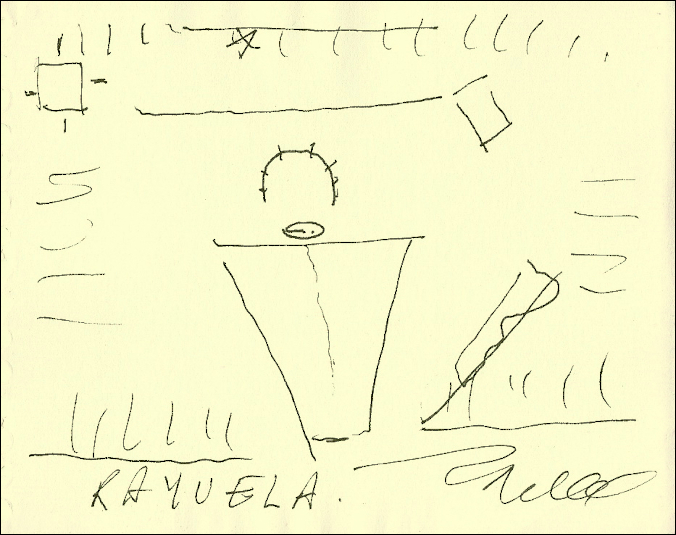
Original sketch by Jorge Polaco (idea for a film about Julio Cortázar) gifted by the filmmaker to Charif (1996)
In October, in coincidence with the 10th anniversary of his first short film as director, the Museum of Modern Art of Buenos Aires organizes a retrospective with 13 of his experimental films that show a series of technical and procedure inventions, one of which, in El primer paisaje de un hombre (The First Landscape of the Man), consists of sticking an extensive microscopic collage to a film stock (previously turned transparent with bleach). In that occasion was released Barroco Natural: el nuevo éxito de la industria del cine (Natural Baroque: The New Success of Film Industry), a six minutes film hand painted throughout eight nights frame by frame.
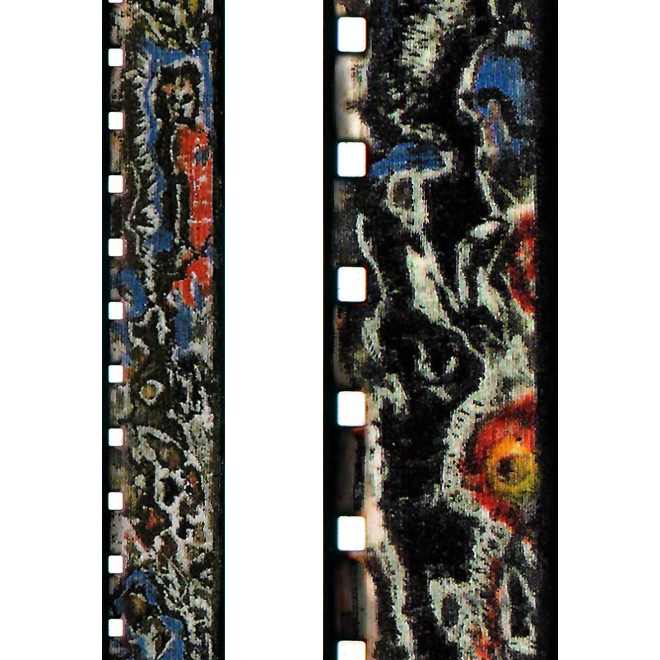
Film stills from Barroco Natural (1997)
In November, after five years away from exhibitions, Falsificaciones (Forgeries) is shown at the Fundación Elía-Robirosa. The series of twenty paintings and eight drawings is inspired on ancient master’s paintings that impressed to Charif in his childhood (Baldung, Cosimo, Cranach, Crivelli, Jan de Flandes, Fouquet and others). There, he combines oil classic techniques (varnishing, glazes) with other thirteen techniques of his own invention. One of this works (Nuestro delirio) is, from 2018, part of the heritage of the Museo Nacional de Bellas Artes of Argentina (National Museum of Fine Arts), which includes works of Bouguereau, Courbet, de Chirico, Degas, El Greco, Fontana, Gauguin, Goya, Kandinsky, Manet, Modigliani, Monet, Pollock, Rembrandt, Rothko, Rubens, Tiépolo, van Gogh and Zurbarán, among others.
Here a selection from Falsificaciones (Folgeries) series. Please, click on thumbnails to enlarge.


1998
The Image Theory Centre organizes a new retrospective with 14 films by Gustavo Charif, in a cycle of screenings with the film directors Werner Herzog, Michael Verhoeven and Werner Schroeter.
Barroco Natural: el nuevo éxito de la industria del cine (Natural Baroque: The New Success of Film Industry) is broadcasted on the TV show Cinelimite (on Bravo / Film&Arts channel), alongside films of Maya Deren, Kenneth Anger, Stan Brackhage, Michael Snow and James Whitney.
In May, Charif is invited to arteBA (the most important international art fair in Argentina). From then, his works will be shown in arteBA regularly.
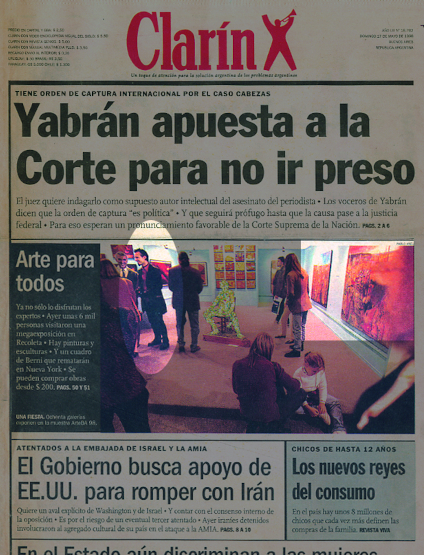
Gustavo Charif in Clarín cover (the largest Argentinian newspaper) during arteBA opening (May 1998)
In July, he plays the role of the male devoured by a wild female in the experimental film Religiosa Mantis (directed by dancer and choreographer Vanina Serra).
In November 1998, he institutes in Buenos Aires the prize Charif pintado de oro (Charif Painted in Gold). The prize-giving ceremony is held at the doors of the Museo Nacional de Bellas Artes (National Museum of Fine Arts) to León Ferrari (career), Alfredo Benavidez Bedoya (engraver), Ricardo Longhini (sculptor), Enrique César Lerena de la Serna -a.k.a. Ithacar Jalí- (sciences), Claudio Caldini (filmmaker), Roberto Bertero (painter) and Daniel Alva (friend). Charif also awards his couple in those days (a dancer and choreographer, as woman) and his lover (a student of architecture, as lover). The prize for the best Argentinian rock band was declared void.
Charif said to the Argentinian press: “This Museum gives prizes to everybody for anything, so, I can give my own prize to the people that I really think deserve it. But, in my case, I am not receiving money or favours under the table (that’s the reason why I give it at the doors and not inside of the Museum). I am not giving a price to my partner as dancer or to my lover as architect, even when they are enough good in their professions… but this is a serious prize. I mean, for example, I have some very good friend who is a very good painter, but I give the prize to other painter that I consider better than him. In this way, the big difference with the prizes that the Museum and his director (Jorge Glusberg) are currently giving, is that, to get the Charif Painted in Gold, you must be, according a honest jury, the really best of the year in your activity. And I know the jury is completely honest because it’s conformed by an only one member: me. And I covered the prizes with a cheap but nice gold paint because I have not enough money to make it in real gold. By the way, if somebody in the audience is enough clever to distinguish at a certain distance the difference between the golden painting and the real gold, then is also enough clever to don’t believe in any prize (even in mine)”.
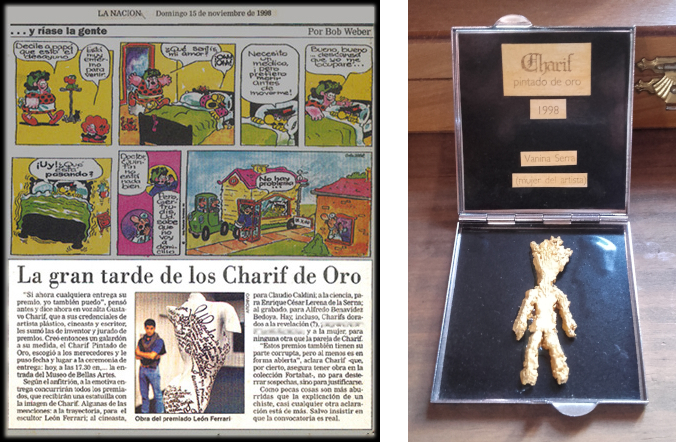
Press about the Charif Painted on Gold ceremony (La Nación newspaper), and the prize given to the winners
In this year started a number of works in which define his own style, starting with big landscapes full of expressionist characters in a kind of informalism ultra-baroque defined by Charif as “rotten baroque” and, a couple of years later, as “incarnated painting“.
In a rare TV interview, we can see him painting one of the first of this works, titled La tierra vuela, pero mi reino es de este mundo (Earth Flies, but My Kingdom Is of This World).
Here a brief selection of 1998 paintings (please, click on thumbnails to enlarge)


1999


Los niños de hoy crecen en barriles martillados (The Children of Today Grow up Into Hammered Barrels, 1999)
oil and oil pastel on canvas · 100 x 200 cm
Charif starts doing drawings, collages and paintings in an absolutely different style, which he signs as Victorio Lenz. A parallel career and biography begins in this way. Some of these collages will be “recycled” some years later in the procedure that he will calls “analogital”.
Please, click on thumbnails to enlarge


In May he’s representing by Daniel Maman Fine Art in arteBA international art fair.
In September, writes Lógica silvestre (Feral Logic), a short text which works as a refutation to the Kant’s Logic at the same time that an epilogue for El cuerpo humano (The Human Body, a collection of poems in which will work for next years). To read Lógica silvestre in original Spanish, please click here.
Ending 1999, Charif founds a religion that does not accept followers, and writes a series of precepts that, being an indecipherable writing, he himself is unable to follow. This writing (titled Main neuf Discours) was sent, via fax and e-mail, to 99 “scientists, philosophers, writers and waitresses” from different countries.

Seven years later, in 2006, Charif will say that he himself was expelled from this religion by him, so from them this ultra-secret sect have not even one single member.
1999 is also the year in which starts the “rotten Neoplasticism” series. Here a brief selection of them (please, click on thumbnails to enlarge).


2000
The expressionist characters that lived in small details into his ultra-baroque informalist landscapes, now suddenly grow and are central in secrets and oppressive interior rooms.
“In some way, the real world is always inside, there where people make unutterable acts and where leaders take secret decisions to run the herd.” -Gustavo Charif.-
Please, click on thumbnails to enlarge


In April the short experimental film Barroco Natural (Natural Baroque) is released in a commercial theatre, the Atlas Recoleta of Buenos Aires.
Soon later arrives to France selected by the Museum Baron Gérard (Normandy) to be part of the exhibition Kaléidoscopies: Arrabal et les artistes, among artists like Jorge Camacho, Salvador Dalí, Maxime Godard, Jean Miotte, Jean-Jacques Sempé, Olivier O. Olivier and writers like Michel Butor and Michel Houellebecq.
He meets filmakers like Jean-Pierre Mocky and Claude Chabrol, and some legendary artists like Olivier O. Olivier express their admiration for Charif.
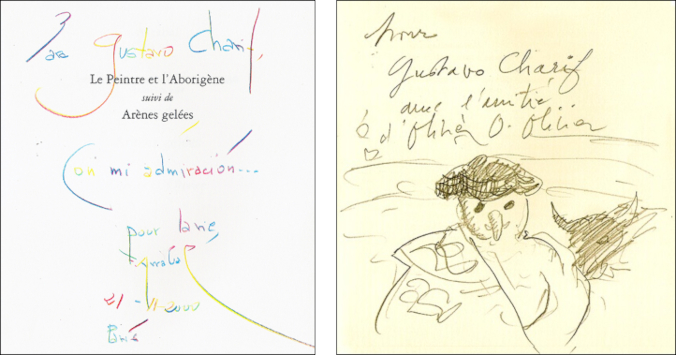
Dedication for Arrabal in a book gifted to Charif: “To Gustavo Charif, with my admiration for his life”,
and drawing by Olivier O. Olivier gifted to Gustavo Charif by the artist (Paris, May 2000)
After that he distributes through all Paris a false cover of Le Figaro magazine which announcing his “invasion to conquest the barbarian French people”, and meets Alejandro Jodorowsky who invites him to a public dialogue about his works and future.

False cover of Le Figaro magazine
The text reads: Save you by yourself: Charif invades Paris! The genial painter, writer and filmmaker will be in the city until June 22, 2000. “I’m here for a meeting with the great Fernando Arrabal, to see a little canvas that I made and which is in Bayeux, in the Museum of Art Baron Gérard, and to conquer this people of savages barbarian!”, says Charif laughing like a nutty. “After me, Laetitia will be no more Chaste!”
Charif attends to the Crazy Horse (the artistic cabaret that surprises him by the style “as full of luminous and optical effects as frontal female nudes”), and have a love affaire with dancer Marielle Tsarine, who will give him the money to make a 16mm short film titled L’enchaînée (“The shackled girl”).
In Paris he made his first artist book, Los primeros civilizados del salvaje oeste de las Pampas (The Firsts Civilized People of the Wild West of the Pampas), today in a private collection.
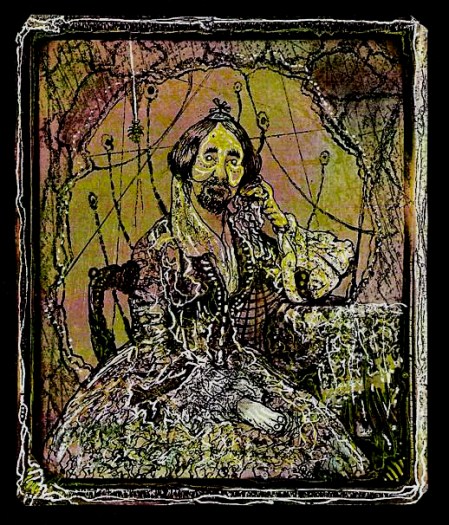
La madre original de todas las madres (The Original Mother of All Mothers)
From the artist-book Los primeros civilizados del salvaje Oeste de las Pampas (The Firsts Civilized People of the Wild West of the Pampas), 2000
He try to design, with the help of experts in physical optics, a system of lens to adds to the eye the proportional vision of a grid (system destined to find a simple and fast learning of drawing). He also develops a theory to create a virtual dark box able to “clones” masterpieces. But both projects abort due lack of funding.
Ending the year, Charif continues with his series of political collages, this time announcing a future crisis of the new government of President Antonio de la Rúa, but warning at the same time of a possible return of the Peronist bunch.
Please, click on thumbnails to enlarge


 Charif · 沙里夫 ·