Birth, facts and some pieces of the puzzle of an unusual life, year by year to the present.
2016
I don’t know how to make a masterpiece, but I know that to learn how to paint or produce art is necessary first to learn how to see. The lines of a bark’s tree, the storm over the ocean, that design of the rainbow leaf beetle (or Chrysolina cerealis) are arguably expressions of the Universe in its subtle and spontaneous manners. In some way, it’s art from a natural talent who never was contaminated by art schools, trends or market.
I only found a museum of art in this natural space, in Guandu, and I stressing the lines using her elements (branches, leaves, stones), but also trash that I found in forests and rivers from different countries (like broken toys) because, as Zuang Zhou (莊子) teach us in that passage about the “useless” Ailanthus (樗), uselessness is useful if we found the usefulness.
This project is strongly linked to my own life, in which I am more and more identify with the useless tree rather than the useful “artist”.
-Gustavo Charif, Taipei, October 2016.-
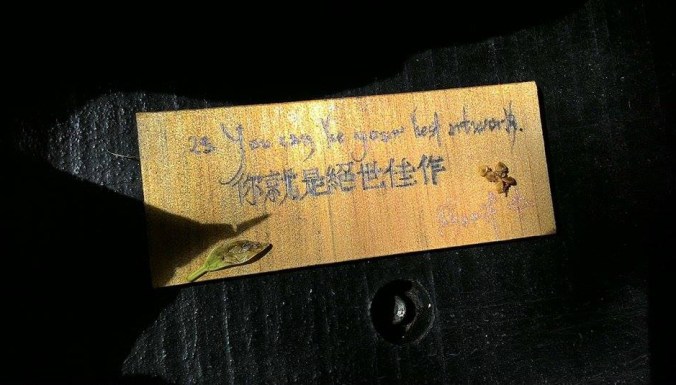
Detail of 你就是絕世佳作 (You Can Be Your Best Artwork, Gustavo Charif, Taipei, 2016)
[Photo by Lin Ya Han, a.k.a. Nemo Lin]
Begins the year working in finishing of a series of micro-collages begun a few years before, but also in some others completely new. The following is a brief selection of them.
Please, click on thumbnails to enlarge


In this year in which Charif focused mostly on writing, starts a friendship with Scottish musician and author Chris Connelly and with Taiwanese multidisciplinary artist Lin Chi-Wei.
In August he writes 自傳 (Autobiography), a Chinese version of the micro-autobiography written in 2010, and in September makes a short experimental film using an old and cheap cell phone, walking in a Taiwan suburban street, and in a single continuous shot (without image or sound edition; with the only exception, of course, for the addition of the opening and closing titles).
From September 9 to December 31, and invited by the 關渡國際自然藝術季 (Guandu International Nature Art Festival), presents in Taipei (Taiwan) 樗—自然裡的美術館 (Ailanthus, or The Living Museum of Art by Nature), his big solo environmental installation consisting in 66 artworks arranged as an exhibition in a natural museum without walls. You can see the full work and process in detail clicking here. The following is a brief seletion of the work.
Please, click on thumbnails to enlarge
![01. [Detail with handmade title.] Enter the Unknown. / 進入未知。 [Foto: Te-Wei Chao.]](https://i0.wp.com/gustavocharif.com/wp-content/uploads/2020/08/x-01-a-te-wei-chao.jpg?w=92&h=92&crop=1&ssl=1)

![01. [Detail.] Enter the Unknown. / 進入未知。](https://i0.wp.com/gustavocharif.com/wp-content/uploads/2020/08/x-01-c.jpg?w=92&h=92&crop=1&ssl=1)


![13. [Detail.] It's Not a Heavy Rain, It's Just an Infinite Weeping. / 這不是雨,只是無盡的哭泣。](https://i0.wp.com/gustavocharif.com/wp-content/uploads/2020/08/x-13-b.jpg?w=92&h=92&crop=1&ssl=1)
![13. [Detail.] It's Not a Heavy Rain, It's Just an Infinite Weeping. / 這不是雨,只是無盡的哭泣。](https://i0.wp.com/gustavocharif.com/wp-content/uploads/2020/08/x-13-c.jpg?w=92&h=92&crop=1&ssl=1)
![14. Natural Vampire. / 大自然的吸血鬼。 [Detail of handmade title.]](https://i0.wp.com/gustavocharif.com/wp-content/uploads/2020/08/x-14-a.jpg?w=80&h=80&crop=1&ssl=1)

![15. [Detail of the handmade title.] Portrait of a Very Hairy Man. / 一個多毛男人的肖像。 [Photo by Te-Wei Chao.]](https://i0.wp.com/gustavocharif.com/wp-content/uploads/2020/08/x-15-a-te-wei-chao.jpg?w=80&h=80&crop=1&ssl=1)


![25. [Detail of handmade title.] You Can Be Your Best Artwork. / 你就是絕世佳作。 [Photo by Lin Ya Han, a.k.a. Nemo Lin.]](https://i0.wp.com/gustavocharif.com/wp-content/uploads/2020/08/x-25-a-nemo.jpg?w=80&h=80&crop=1&ssl=1)
![25. You Can Be Your Best Artwork. / 你就是絕世佳作。 [Photo: Charif protrayed by the assistant Pei-Pei Dai before the work.]](https://i0.wp.com/gustavocharif.com/wp-content/uploads/2020/08/x-25-d.jpg?w=80&h=80&crop=1&ssl=1)
![25. You Can Be Your Best Artwork. / 你就是絕世佳作。 [Photo: the assistant Pei-Pei Dai protrayed by Charif before the work.]](https://i0.wp.com/gustavocharif.com/wp-content/uploads/2020/08/x-25-f.jpg?w=80&h=80&crop=1&ssl=1)

![26. [Detail.] Winner of Nothing. / 全盤皆輸。 [Photo by 康錫頂 (Kelvin Kang)]](https://i0.wp.com/gustavocharif.com/wp-content/uploads/2020/08/x-26-c-e5bab7e98cabe9a082-kelvinkang.jpg?w=80&h=80&crop=1&ssl=1)
![26. [Details.] Winner of Nothing. / 全盤皆輸。](https://i0.wp.com/gustavocharif.com/wp-content/uploads/2020/08/x-26-d.jpg?w=80&h=80&crop=1&ssl=1)
![26. [Details.] Winner of Nothing. / 全盤皆輸。](https://i0.wp.com/gustavocharif.com/wp-content/uploads/2020/08/x-26-f.jpg?w=80&h=80&crop=1&ssl=1)
![28. [Detail.] Poetry From the Forest. / 森林之詩。](https://i0.wp.com/gustavocharif.com/wp-content/uploads/2020/08/x-28-b.jpg?w=80&h=80&crop=1&ssl=1)
![28. [Detail.] Poetry From the Forest. / 森林之詩。](https://i0.wp.com/gustavocharif.com/wp-content/uploads/2020/08/x-28-c.jpg?w=80&h=80&crop=1&ssl=1)
![28. Poetry From the Forest. / 森林之詩。 [Photo by 康錫頂 (Kelvin Kang)]](https://i0.wp.com/gustavocharif.com/wp-content/uploads/2020/08/x-28-f-e5bab7e98cabe9a082-kelvinkang.jpg?w=80&h=80&crop=1&ssl=1)

![52. Maelstrom in the Stones River. / 石頭河中的渦流。 [Photos by 莊雅惠 (Naffy).]](https://i0.wp.com/gustavocharif.com/wp-content/uploads/2020/08/x-52-c.jpg?w=80&h=80&crop=1&ssl=1)


![First days. Talking with photographer Kelvin Kang (康錫頂), sketch of the day's plan according each artist and a Charif's friend captured by the lens of Yenzi in the pocket of the artist. [Photos by Yen-ju Lai and Yenzi.]](https://i0.wp.com/gustavocharif.com/wp-content/uploads/2020/08/x-process-02-photos-by-yen-julai-and-yenzi.jpg?w=80&h=80&crop=1&ssl=1)
![First ideas in the Charif's sketchbook. [Photo by Yenzi.]](https://i0.wp.com/gustavocharif.com/wp-content/uploads/2020/08/x-process-03-yenzi.jpg?w=80&h=80&crop=1&ssl=1)
![With assistant Pei-Pei Dai. [Photo by 康錫頂 (Kelvin Kang)]](https://i0.wp.com/gustavocharif.com/wp-content/uploads/2020/08/x-process-04-e5bab7e98cabe9a082-kelvinkang.jpg?w=80&h=80&crop=1&ssl=1 "康錫頂-KelvinKang")
![Modeling clay. Working in 全盤皆輸 ("Winner of Nothing"). [Photo by 康錫頂 (Kelvin Kang).]](https://i0.wp.com/gustavocharif.com/wp-content/uploads/2020/08/x-process-12-e5bab7e98cabe9a082-kelvinkang.jpg?w=80&h=80&crop=1&ssl=1)
![Installing 金鳥 ("Golden Bird") and talking with photographer visitor. [Photo by 康錫頂 (Kelvin Kang).]](https://i0.wp.com/gustavocharif.com/wp-content/uploads/2020/08/x-process-14-e5bab7e98cabe9a082-kelvinkang.jpg?w=80&h=80&crop=1&ssl=1)

![Explaining to Taiwanese families and children how to make art by themselves. Talk during the opening day. [Video capture.]](https://i0.wp.com/gustavocharif.com/wp-content/uploads/2020/08/x-y-30.jpg?w=80&h=80&crop=1&ssl=1)


![Gustavo Charif (standing, at the centre), the team of Guandu Park, and the other artists selected by the festival: Elena Redaelli (Italy), Lilli Tölp (Estonia), Matt Chun (Australia) and Chi-Hao Pai (Taiwan). [Photo from the catalogue-book.]](https://i0.wp.com/gustavocharif.com/wp-content/uploads/2020/08/x-y-36-cat-lastnight-team.jpg?w=80&h=80&crop=1&ssl=1)
Meanwhile works in Microfilms, a series of short-stories (one of which will be the basis to a feature film script) on a proposal from Dieter Meier. In the other hand, starts the pre-production of Something Else (IMDb data sheet here), an experimental feature film inspired by an idea from Orson Welles.
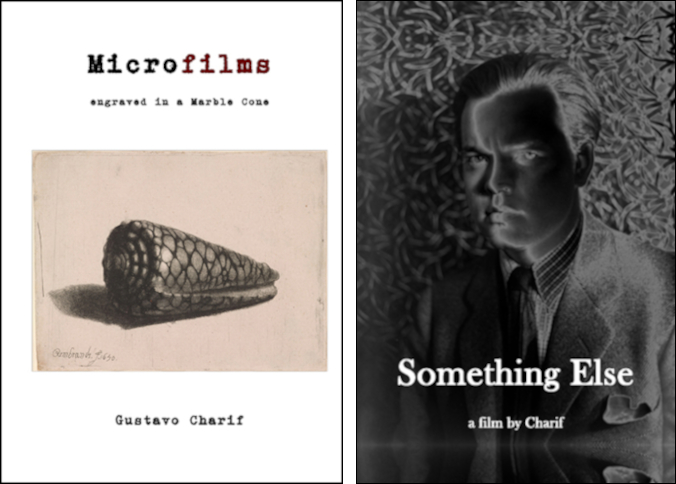
Cover of Microfilms (with an engraving by Rembrandt), and poster (draft) of Something Else
2016-2017
Maman Fine Art turns 15 years and celebrates it with an anthological exhibition, from November 22, 2016 to March 20, 2017. Works of Benito Quinquela Martín (1890-1977), Emilio Pettoruti (1892-1971), Alicia Penalba (1913-1982), Enio Iommi (1926-2013), Marcelo Bonevardi (1929-1994), Alberto Greco (1931-1965), Rómulo Macció (1931-2016), Nicolás García Uriburu (1937-2016), Norberto Gómez (1941), Gustavo Charif (1966), and others.
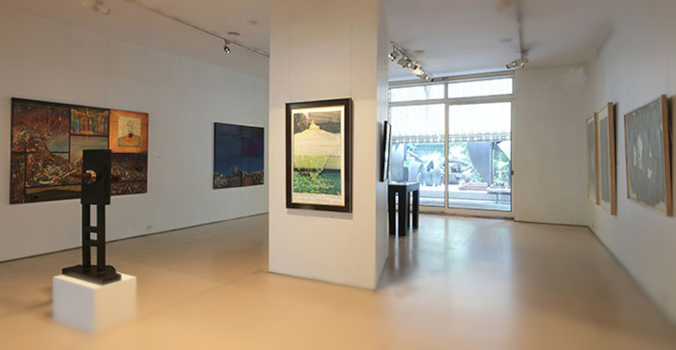
Two large artworks by Charif at the sidewall of Maman Fine Art gallery during the exhibition
2017
Begins a correspondence with Japanese musician Damo Suzuki.
In June 13 is released in USA Are They Cannibals?, the music video for the abstract metal band DIMESLAND. In case you want to buy the full album, please click here.
On July reappears for a while in Buenos Aires, Argentina, as curator of the solo exhibition of the young painter Nicolás Romano in Zamora gallery. The exhibition includes a canvas painting in collaboration bewteen both artists, and Charif writes a conceptual text for the exhibition, which is distributed among the visitors rather than a catalogue. To read the original text in Spanish please click here.
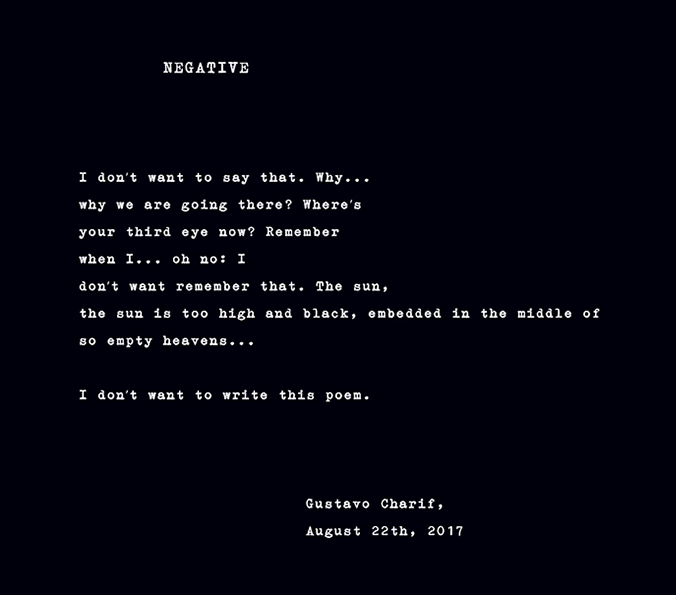
The whole year keeps active the litblog (gustavocharif.tumblr.com) and publishing there some poems for Puns and Poses, a new book in progress. Please, click in the following titles in case you want to read some of them: A Little Poem with Your Name, Negative, Suicide Has No Music, No Idea, but the Common Sense, Voice. At the same time, creates a series of digital collages set on engravings, to illustrate the poems. Here one of them (with details).
Please, click on thumbnails to enlarge


From more than fifteen years, ever since Kirchnerists (the “new” Peronists) defines their movement as “national and popular”, Charif is defined, regarding Argentine politic, as “international and unpopular”.
This year, dissenting more than ever with the options in the recent Argentine elections, the PIEI (Partido Internacional E Impopular, or international and unpopular party) is born and it’s launched through social networks. Charif offered flyers and ballots via Internet, and whoever wishes is free to print their own ballot to vote.
Caution: of course, it’s not really a political party but an art action.
Please, click on thumbnails to enlarge


On October develops a new language with a secret code (called “embryonic alphabet”) invented to compose a new book: the KripTotemBuch.
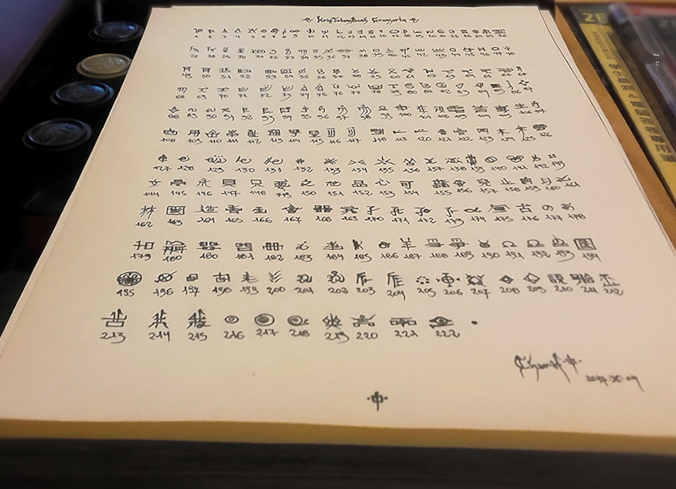
KripTotemBuch Gramartu (2017)
Ending the year, the Museo de la Palabra (Museum of the Words, Toledo, Spain) grants him the title of Embajador de la Palabra (Ambassador of the Word), title with which the museum honours “writers whose works promote peace and concord between different cultures”. His first action as ambassador consisted in ask to 22 artists, very different each other, a quotation from their own culture to share with the world. The action-document is completed on next year and sent to the museum with the title XXIII. The artists collaborating with a quotation are (in alphabetical order): Afa Annfa (Hong Kong), Catrine Val (Germany), Chris Connelly (Scotland), Claudio Caldini (Argentina), Elena Redaelli (Italy), Lars Teichmann (Germany), Lili Wilde (Portugal/UK), Liu Bolin (China), Lui Itzel (Mexico), Marianna Ignataki (Greece), Mei Melançon (Philipines), Molly Harvey (Unites States), Nolan Cook (Unites States), Paul Barnes (Scotland), Raúl Herrero (Spain), Ray Caesar (England), Saffie Ng (Australia/China), Yasuaki Shimizu (Japan), Yeom Ji-hee (South Korea), Yohanna Idha (Sweden) and Zhangxu Zhan (Taiwan). To read the document, please, click here.
In the last day of the year, Charif edits a new visual virus, Enlightenment, that will be online on January 1th 2018. Same day in which he’ll write a new poem titled Once and for Ever.
2018
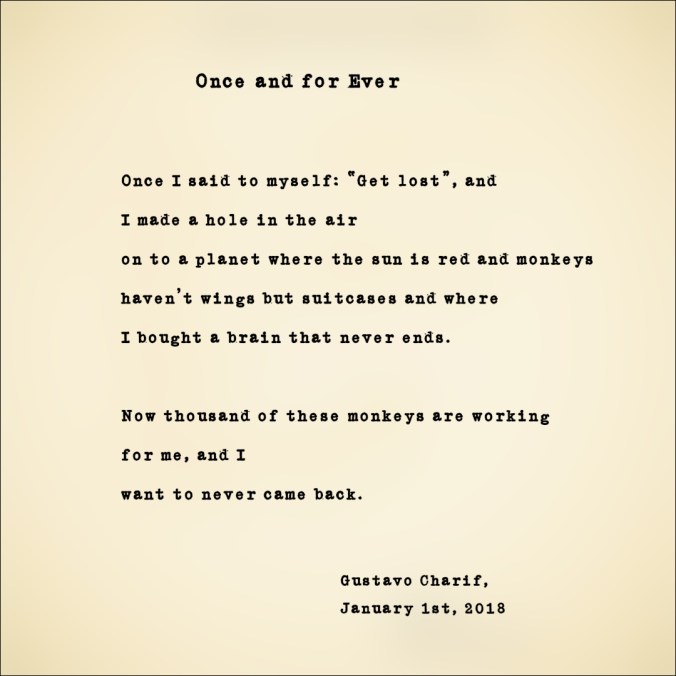
Once and for Ever (original poem by Charif)
The year begins with a good new: the big canvas Nuestro delirio (1995/1996) became part of the heritage of the Museo Nacional de Bellas Artes (National Museum of Fine Arts) of Argentina. The Museum’s heritage includes works of Bouguereau, Courbet, de Chirico, Degas, El Greco, Fontana, Gauguin, Goya, Kandinsky, Manet, Modigliani, Monet, Pollock, Rembrandt, Rothko, Rubens, Tiépolo, van Gogh and Zurbarán, among others.
Please, click on thumbnails to enlarge


February, 2018: worldwide premiere of Ophelia Moment -demo version-, oficial music video for Chris Connelly (official site here). At the same time, starts a YouTube series in Spanish that mix comedy, documentary, philosophy, autobiography and some experimental techniques. The series, about an alien from an unknown planet who comes to the Earth, is titled Informe Irenäus (Irenäus Report), a name inspired by specialist in human ethology Irenäus Eibl-Eibesfeldt. Clicking here, you can see the full series (original in Blajtinubrii, which is the alien’s language, and with Spanish subtitles).
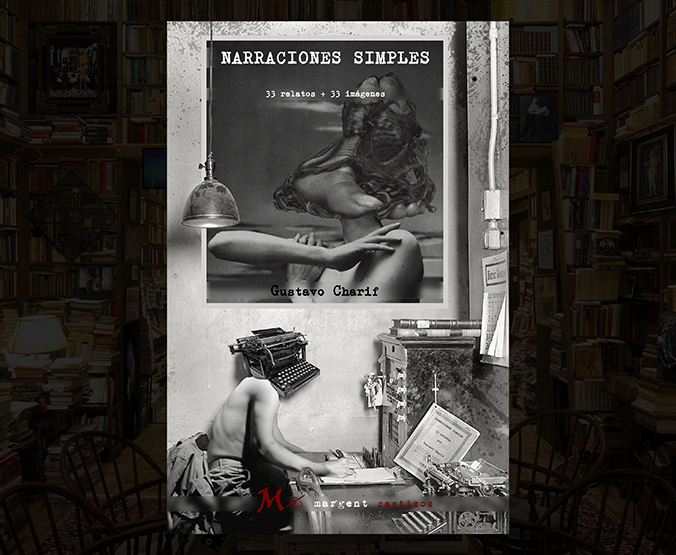
On June, appears the first edition of Narraciones simples (Simple Narratives), a book with 33 stories in Spanish which includes 33 images made with the analogical technique (a procedure of his own invention). Click here to see or buy the book via Amazon. More about the visual technique in the ANALOGITALS sub-section into FINE ARTS section.
September begins with a new visual virus (Missing Scene, Missing Life), and with the idea of a new short film inspired by footage taken by his friend Alla Naumova (a.k.a. Alla En) during some days in La Croisette, Cannes, France. This film will be finished in 2020 with the title of Last Words.
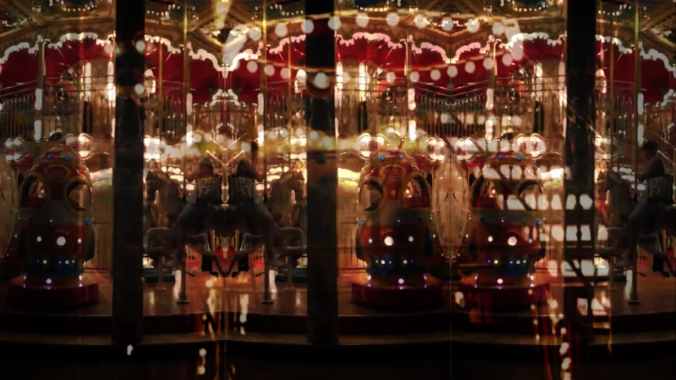
Film still from Last Words (image by Alla Naumova & Gustavo Charif, 2018)
The year that started with a poem, is ending with a funny prose poem titled My Heart Is Big Enough for Both of Us. Feel free to read it just clicking here.
2019
You can read in Matthew (VII, 16), “you will know them by their fruits”. Well, I have a lemon tree… Which does not make any sense, I guess.
-Gustavo Charif, Pocket Bible, November 24, 2019.-
On February 11 creates La mosca en la ópera (The Fly at the Opera), the first micro-novel, a visual-novel which fit in a single small page and that includes the keys of the plot.
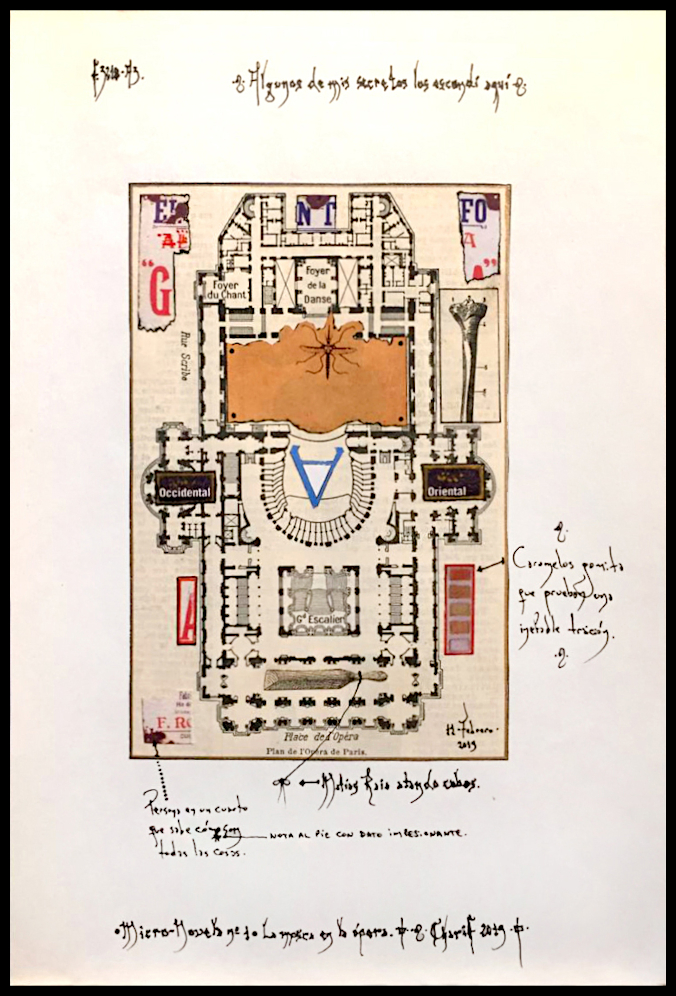
La mosca en la ópera (The Fly at the Opera, 2011)
micro-novel, literature, collage, ink, golden ink, pencil and oil pastel on paper (23 x 15,5 cm)
April 23: Release of Gente iluminada (Enlightened People), an eleven minutes film made entirely using found footage and public domain old footage, reframed, colored and with the addition of different visual effect. In spite of be the film number 33 in his filmography, and in spite of to be made on found footage, Charif consider it “my first good storyline film, and maybe my first good film in general”. To see the full film (original in Spanish) please click here or in the poster image.
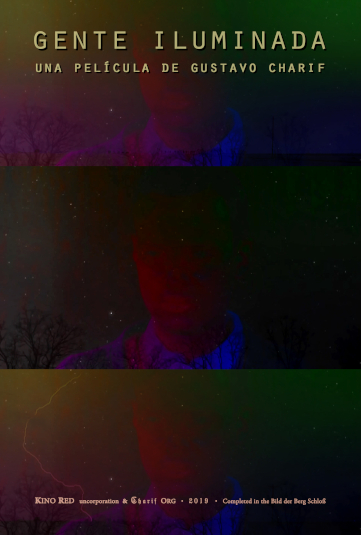
Gente iluminada (poster, 2019)
In the same month releases a video series with a new concept: concentrated conferences like philosophical “pills”. The series is called Micro-Filosofía (Micro-Philosophy), and each episode presents to Charif giving a new lecture from Singapore. Curiously, the lectures are talkie in “Luzanian” with Spanish subtitles, and Charif is presented as a faceless virus-man. In 2019 will be release three micro-conferences, and the series continuous today.
(Note: There are a project to translate the whole lectures into English some day. By the moment, clicking here you can see all the original episodes in Spanish.)
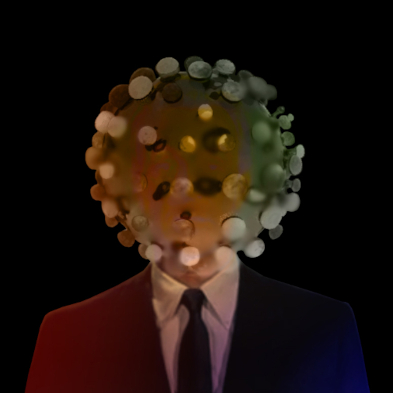
Charif as the Virus-Man, a character that was projected a few years ago and which will be meaningful in the following year
Please, click on thumbnails to enlarge


Shortly later, on May, he creates a video-exhibition with a selection of his analogitals works, video that works as experimental documentary with traits of comedy, and in which the music is composed and performed entirely by Charif himself. But the relevant point with this film is that it is, in fact, a solo exhibition that brings together most of his analogital work; although is not in a museum or in an art gallery, but on the Internet through a video presented in YouTube.
In the same month makes two experimental short films originally in English (please, feel free to see them clicking in the following titles): Threesome and Voices in the Labyrinth (visual virus #7). In October, Charif will make a new YouTube series called Casita robada, not so much a parody of House of Cards TV series as a parody of the Argentina political current times.
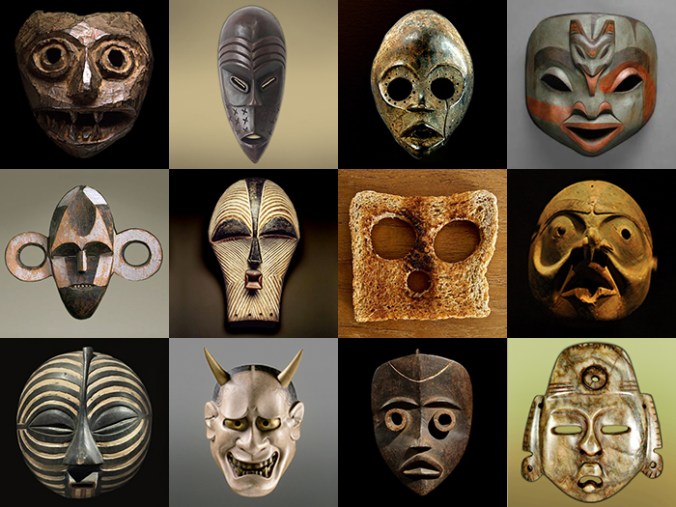
Toasterian Mask (digital collage, 2019)
“Part of my amazing collection of tribal masks. Among them we can see the very rare ceremonial mask from the Toasterian tribe of the Panetone Isles.” -Charif.-
On September, writes a long article in his litblog which starts talking about the Venezuela political situation to ends talking (even ironically) about how the concept of “revolution” is still changing not just according different convenience in politic but also according trends, or capriciously according individual moods and even in the text itself that Charif is on writing. The text (Del entusiasmo… y su pérdida inmediata) can be read, in Spanish, clicking here.
(Note: there are a project of collecting all the political articles and essays in a short book to be read online coming soon.)
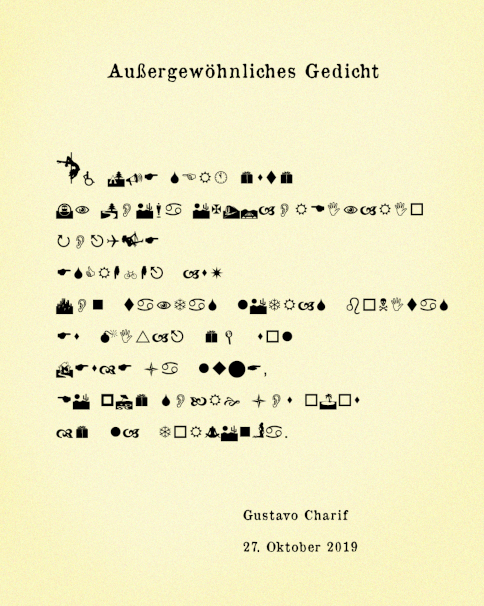
Außergewöhnliches Gedicht. (Esto lo escribí de pie sobre los ojos de una tormenta.) / Extraordinary Poem. (I wrote this standing over the eyes of a storm.)
The year, mostly dedicated to writing the script proposed by Swiss entrepreneur and multi-disciplinary artist Dieter Meier, is ending with an autobiographical micro-tale (The Cure for Innocence) followed by a digital photo-montage as illustration (Memory from Hell).
Please, click on thumbnails to enlarge


 Charif · 沙里夫 ·