Birth, facts and some pieces of the puzzle of an unusual life, year by year to the present.
1982
The Falklands War (Guerra de Malvinas) begins on April 2, confronting Argentina with the United Kingdom. In those days Gustavo Charif writes a Manifiesto de arte ambiguo (Manifesto of Ambiguous Art), a text that works more like an anti-dogmatic statement than a manifesto per se, and begins exhibiting his drawings, paintings and collages in Buenos Aires.
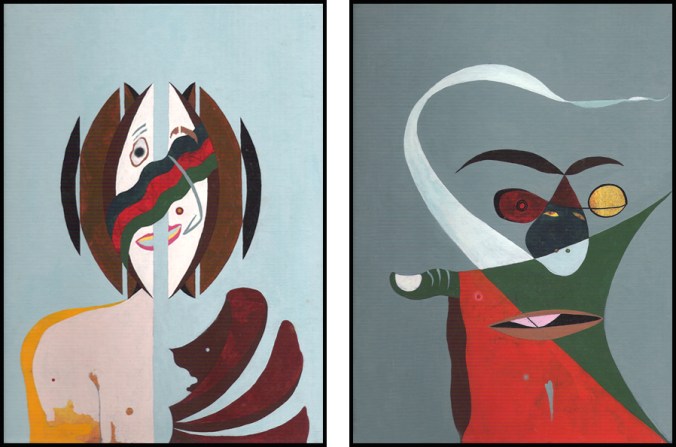
Bobo frente a un espejo (Chump Before a Mirror) and Tonto enojado (Angry Fool)
enamels on canvas set on cardboard, circa 1981
In June, not so much for spiritual intentions as ethological reasons, he travels once again to Luján, in a pilgrimage with the Christian crowd to listen to the Pope John Paul II. The Falklands War ends three days later and Charif back home even more atheist than a week earlier. Around that time he met the outsider drawer, collagist and painter Roberto Bertero with whom establishes a long friendship.
Immediately thereafter, Charif attends Theosophical Society’s sessions but, at the same time, to meetings of the Trotskyist party, and talking to the firsts like a fervent revolutionary to needed be converted and to the Trotskyists like if he were a convinced Spirist.
Meanwhile composes Juices, a suite for eleven instruments that performs with musicians of classic extraction and free jazz, among whom is the percussionist Horacio Contursi. Around this time, Gustavo Charif has his first meeting with Jorge Luis Borges.
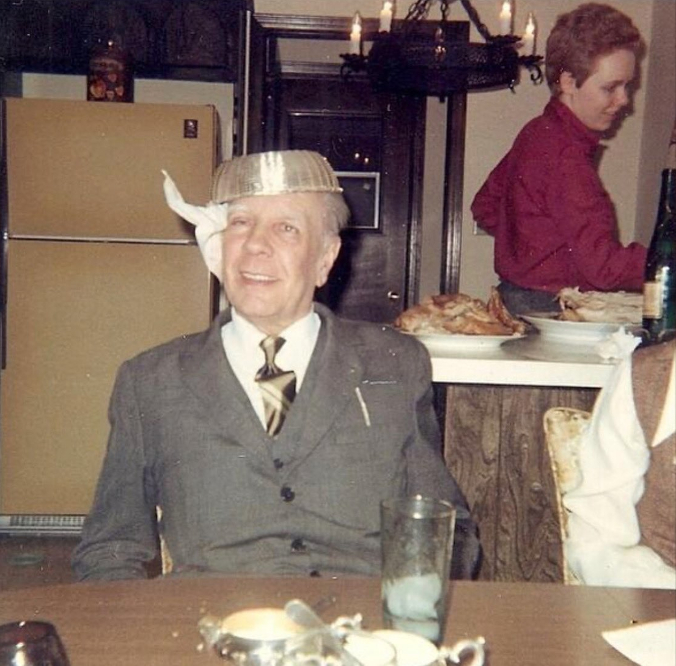
Jorge Luis Borges having fun
1983
Remembering the lessons of Francesco Penacca (a dead painter whom met in his childhood), Charif tries to complete his technical education as painter and made some canvas in classic way. At the same time, he takes interest in epistemology, hobby that lasts until today.
Begins his experiences with all sorts of drugs, experiences abruptly abandoned seven to eight years later.
“Two group of people (that is young people who wrongly think that experience is equal to knowledge and older people who secretly bemoan their youth lived), always ask me the same things: in which things drugs enriched me, what was the most interesting that happened to me in those times, how my “art” changed after that, and so on. So, clearly, all of them take for granted that drugs give you knowdlege, skills or even “visions”. And that is absolutely stupid. When I look back and come up against my drug memories, I olny have something to say: what a waste of time!” -Gustavo Charif.-
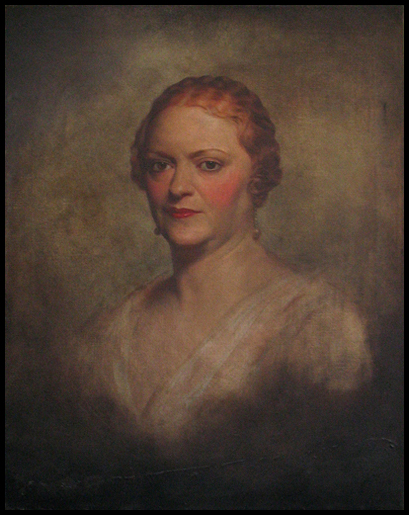
Scotland (circa 1983-1986) · oil on canvas · 80 x 60 cm
1984-1989
Nobody knows exactly where or how he lives most part of time in the following six years: experimental filmmaker in Buenos Aires, partygoer in Berlin, adventurer in Manila…? Probably he start collaborating as scenographer with some European film directors and réggisseurs. Charif has been always reluctant to talk about those “lost years”. Anyway, there are a few facts…
Gustavo Charif starts his long friendship with Federico Manuel Peralta Ramos and Enrique Lerena de la Serna (aka Ithacar Jalí), he begins a travelling life, studies restoration of painting, régisseur and set design, investigates destructive sects and pseudo-sciences, and has numerous and various relationships with young women. Between travels, Charif reappear in Buenos Aires to make some short films before disappear time and again.
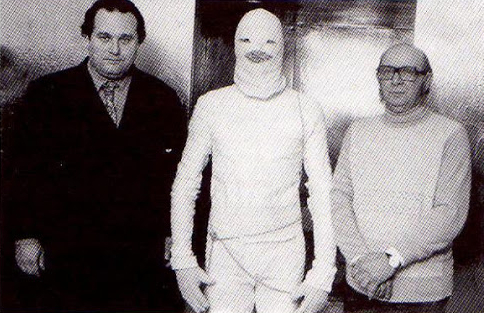
Federico Manuel Peralta Ramos, Ithacar Jalí and Antonio Berni (1976)
On those days Charif invents an “embryonic language” which “gives words back their possible etymological meaning with the paradoxical purpose of discovering their original intent at the same time to manifest their mystery”. He develops the rules of this language, structured on primitive languages, in a Manual and Dictionary of Embryonic Grammar. Soon after, destroys thirty books written in his childhood, before 1980 (two poems collection, two of philosophy, a short novel, twenty-five of tales) and all his songs.
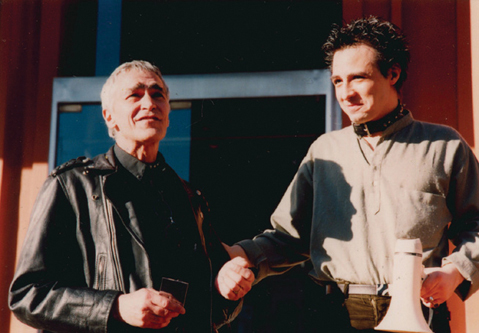
Ethologist Enrique Lerena de la Serna (a.k.a. artist Ithacar Jalí) receiving the “Charif Painted in Gold” prize, at the doors of National Museum of Fine Arts (Buenos Aires, November 1998)
On first months of 1986, Charif has his last meeting with Jorge Luis Borges, who gives him a walking stick and a book from his library. A year before, Borges gave him another two books. Between 1986 and 1989 he writes under the pseudonyms of Melissa Larta, Cesare Cartago and Emmanuelle Vaere as if he were respectively a young Rumanian poet, a mature Italian pornographer and a middle-aged Dutch experimental novelist.
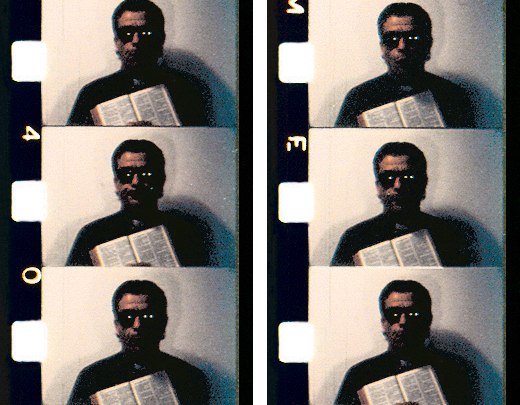
Film stills with Tom Lupo as a priest in Charif’s film Sacred Chewing Gum (1989)
From 1987, Gustavo Charif collaborates with Tom Lupo (and Argentinian radio broadcaster and rock journalist) in the new foundation of the Partido al Medio (a kind of political party with philosophical intentions). The candidate to Minister of Internal Affairs should be the rock singer Luca Prodan (frontman of the band Sumo). The party’s name is a pun, since the word “partido” in Spanish means political party but also “split” or “divided”, thus “partido al medio” means split or divided by the middle.
Prodan and him share the idea to make three music videos, with Prodan acting and Charif directing, but the singer dies before do it. Same year, with Nestor Klem and Pablo Cristofanetti, Charif founds Gomorrita, a filmmakers group. They produce experimental music videos showed in several television channels. From then, Charif directs more than forty short films (mostly in Super 8 and 16 mm, but recently using all kind of new technologies).
After Prodan’s death, and when Tom Lupo supports President Menem and the official party, Charif renounces forever to Partido al Medio and mantains the distance of all kind of political organizations and social groups.
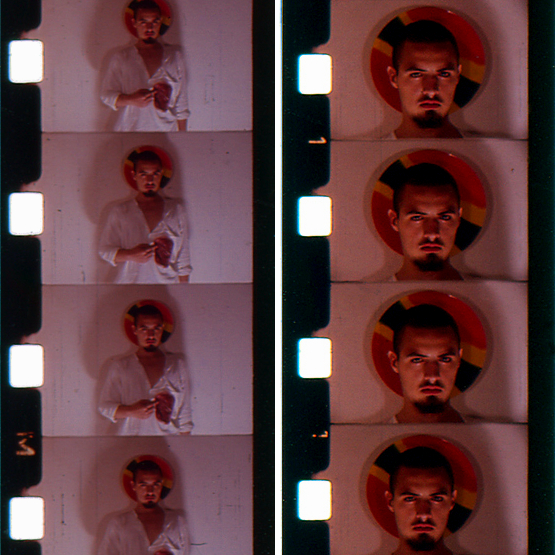
Film stills with Charif as a psychedelic post-punk Christ in Verklärte Nacht (1987-1988)
Starting from “the inherent subjectivity of all theory”, he writes in 1988 pseudoscientific essays that he himself refutes, and founds the Organización Internacional de Sofística (International Organization of Sophistic), which “does not accept any member due this organization rejects debates”. In the same year, he writes a Teoría científica de la transmigración sin almas (Scientific Theory of the Transmigration Without Souls), based on the quantum physics, the recent investigations about neutrino ray and the coincidences among Daoism, Tantric Buddhism and diverse ancient philosophies.
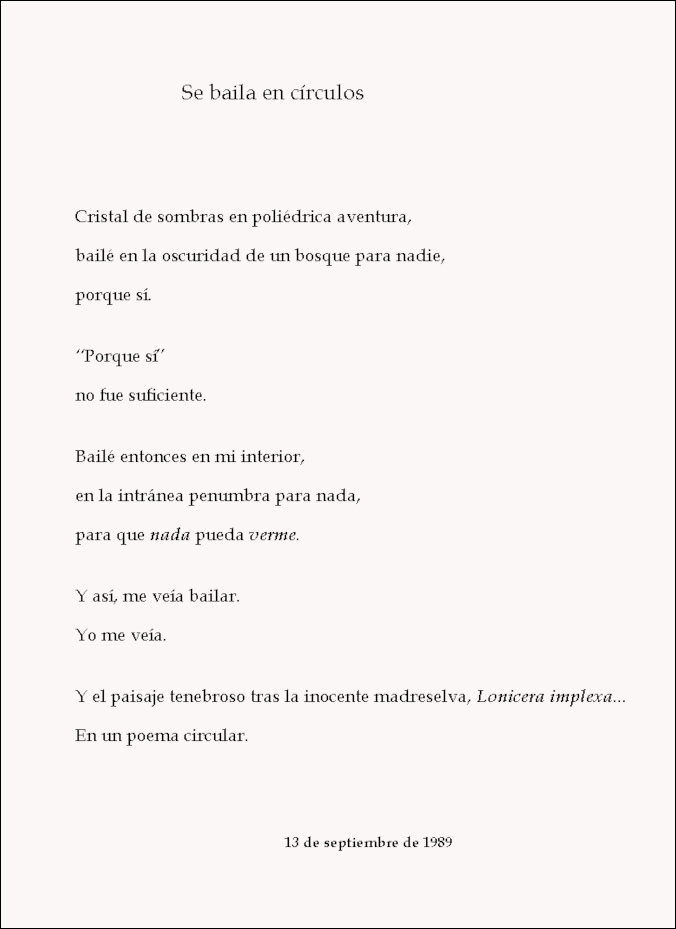
Original poem by Charif
In 1989 Gomorrita (that is Cristofanetti-Klem-Charif) is appointed Special Guest for the collection of their work at the First Biennial of Young Art (Centro Cultural Recoleta, Buenos Aires).
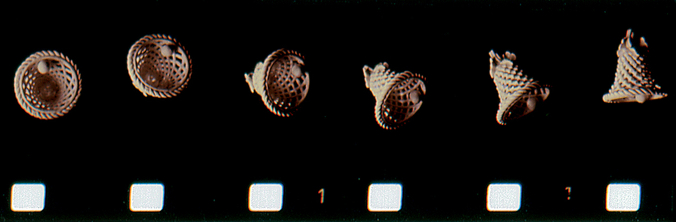
Film stills from Sacred Chewing Gum (1989)
1990-1994
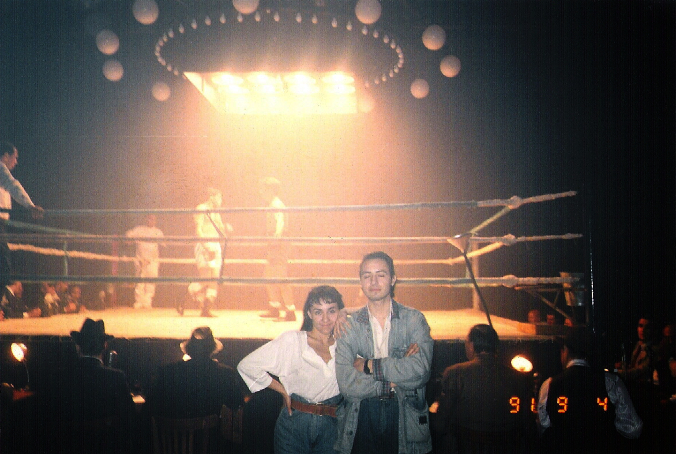
Charif on the film set of Gatica, el mono (1993), with an apprentice-assistant
Gustavo Charif abandons his experiences with drugs and settles in Buenos Aires where collaborates with the remembered film director Leonardo Favio in the production of the feature film Gatica, el mono. His only daughter (called Justine) dies before born.
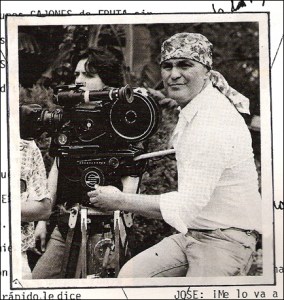
Working with Leonardo Favio
Without money to buy classic materials he makes artworks with all kind of boxes and “ignoble” materials and calls them Putrefacturados (pun mixing Spanish words “podrido” with “manufacturado” that means, respectively, “putrid” and “manufactured”). He signs them with a rubber stamp that belonged to his father’s shops (the only object preserved from the bankrupt family business).
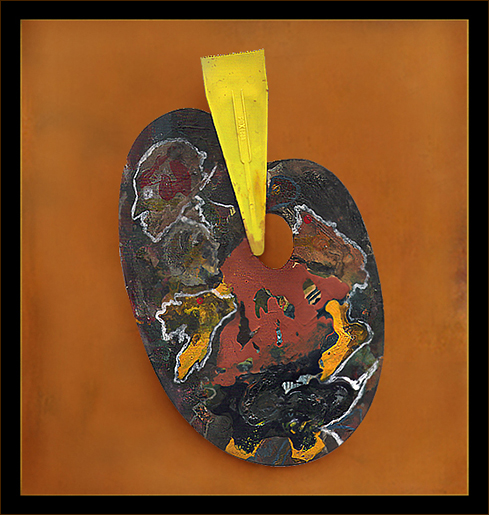
Bart Simpson se aburguesará (“Bart Simpson Will Be a Bourgeois”, 1993) Enamel, oil, assemblage (blade of glue) on palette set on canvas · 50 x 50 cm
Charif decides not to take part in official art exhibitions or Argentinean competitions after that one of his works sent from a competition organized by the CAYC (Centro de Arte y Comunicaciones) was returned unpacked.
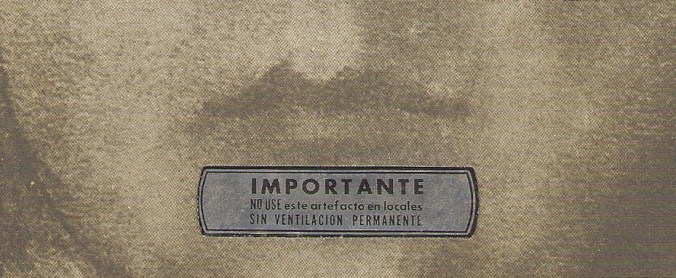
Detail of La Alquimia (“The Alchemy”, 1990)
For more than two years Charif writes the film script Recontrapoder with painter Luis Felipe Noé (father of filmmaker Gaspar Noé). On November 1992 he meets the choreographer and dancer Vanina Serra, with which he’ll live about seven years.
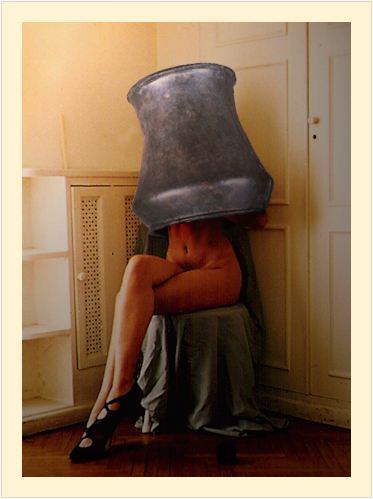
Vanina según Bruegel (Vanina Serra photographed by Charif, circa 1992-1993)
Soon later works as art director in the photographers group Malandro (founded by Pablo Storino and Claudio Peque), with whom develop Fotodance, a series of performances that take four weekends at the nightclub Age of Communication.
At the end of 1994, curator Florencia Braga Menéndez proposes him an exhibition with his putrefacturados at the Palais de Glaçe (National Palace of Arts). But Charif rejects to show his works “until make a series of works that be ashamed me less”. In that spirit he starts the series Falsificaciones (Forgeries) that would be exhibited almost four years later.
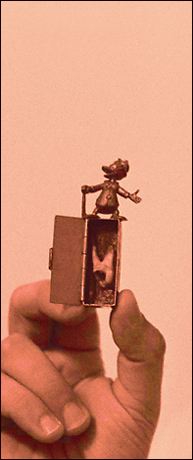
The Triumphant (circa 1993)
micro-assemblage, polyester resin, human molar tooth, blood, metal box and oil paint
1995
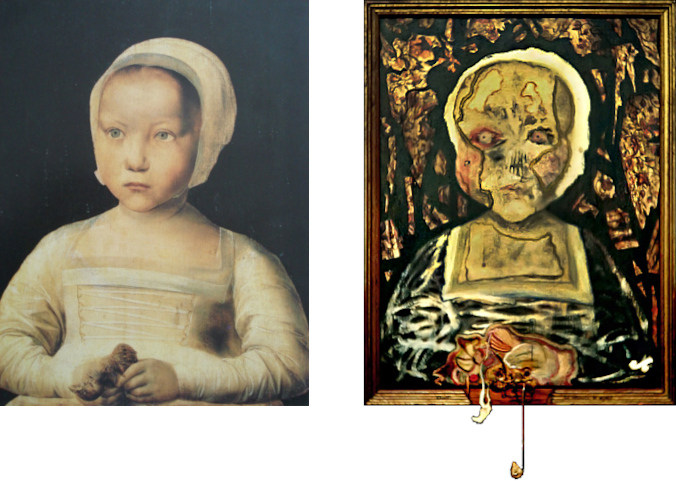
La niña del pájaro muerto (Young Girl with a Dead Bird; oil on canvas, circa 1460-1519; Musées royaux des Beaux-Arts de Belgique collection) by Juan de Flandes, and La infancia de mamá (My Mom’s Childhood; oil, fire, oil pastel and assemblage on canvas, 1995; Enrique Bullrich collection) by Gustavo Charif
Charif writes the play Misa Negra, o La filosofía en el mundo real (Black Mass, or Philosophy in the Real World), losely based on Sade’s writings but set on the Argentinian politics in current times, studies scenography at the Teatro Colón of Buenos Aires (the main opera house in South America), and works as store designer for a big retail music chain.
Please, click on thumbnails to enlarge


Soon after this, founds and runs the Compañía de Teatro Lunar (Lunar Theatre Company) and creates a new theatrical genre, the caprela, which is, in Charif’s words, a “sort of dramatic poem or choreography without dance, that takes its name from the arthropod, due having an external skeleton and being divided in segments or articulations”.
His friend Gaspar Noé talks him with enthusiasm about a friend, filmmaker Claudio Caldini. After see his films, Charif states that Caldini is “the most inspirational, talented and creative filmmaker from Argentina”. Gaspar Noé introduces them, becoming friends.
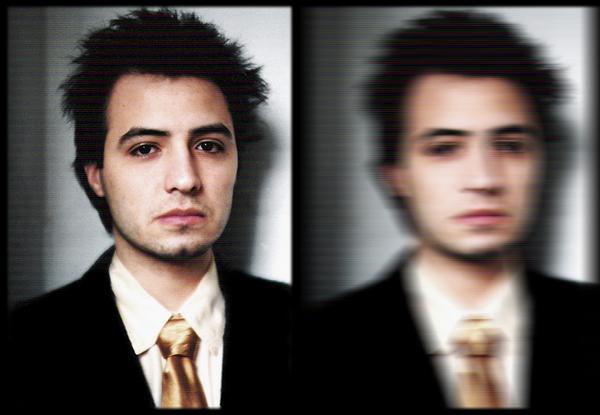
Gustavo Charif in 1995 (Photo by Vanina Serra)
1996
After a personal crisis, during a short homeless period Charif sleeps in parks, borrowed places or at the Biblioteca del Congreso de la Nación (Public Library of Congress).
Back in life, he structures and essays the first caprela based on Paul Hindemith’s opera Sancta Susanna, and writes a farce in five acts titled Ceferino y Gardel fueron amantes (Ceferino and Gardel Were Lovers).
Thinking in an adaptation from a piece by Fernando Arrabal, Gustavo Charif sends to him a fax with a short letter and a scene from his play Misa Negra, o La filosofía en el mundo real (Black Mass, or Philosophy in the Real World). Meanwhile, continues the series of political collages started a couple of years before.
Please, click on thumbnails to enlarge


 Charif · 沙里夫 ·